Outsourced Payroll Services: How to Simplify Payroll Management and Reduce Administrative Work
Running payroll is more than calculating employee wages and sending payments. Businesses also need to manage deductions, payroll records, tax requirements, employee information, reporting, and deadlines. As a company grows, these responsibilities can consume significant time and create additional administrative pressure.
Outsourced payroll services provide an alternative by allowing a specialized third party to manage some or all of the payroll process.
For businesses considering this approach, the important question isn’t simply whether payroll can be outsourced. It’s whether outsourcing fits the company’s size, workforce, internal resources, and need for payroll expertise.
What Are Outsourced Payroll Services?
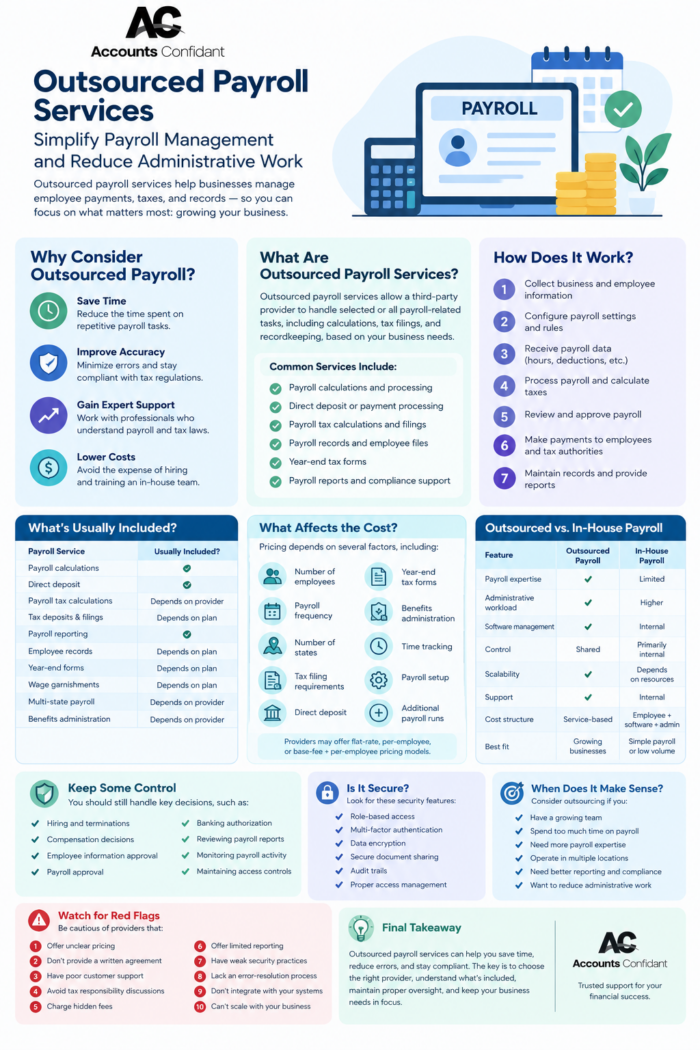
Outsourced payroll services involve hiring an external provider to perform selected payroll-related tasks on behalf of a business.
Depending on the agreement, a provider may help with:
- Employee payroll calculations
- Wage and deduction processing
- Payroll records
- Direct deposit or payment processing
- Payroll reports
- Tax calculations
- Employment tax filings and deposits
- Year-end payroll forms
- Employee payroll documentation
- Payroll-related administrative tasks
The exact responsibilities vary by provider and service agreement.
For U.S. employers, outsourcing payroll does not automatically transfer every legal responsibility to the service provider. The IRS explains that employers generally remain responsible for federal employment tax obligations even when payroll duties are delegated to a third party, although specific third-party arrangements can change liability.
Why Payroll Becomes Difficult as a Business Grows
Payroll may appear straightforward when a company has only a few employees. Complexity can increase when the workforce expands.
For example, a growing company may have to manage:
- Different employee pay rates
- Overtime
- Bonuses and commissions
- Paid time off
- Employee benefits
- Multiple pay schedules
- New hires and terminations
- Payroll deductions
- Multiple work locations
- State-specific requirements
- Year-end reporting
More employees also mean more payroll data that needs to be reviewed and maintained.
This is one reason businesses may eventually consider moving from an entirely internal payroll process to outsourced support.
What Can an Outsourced Payroll Provider Handle?
Not every provider offers the same services, so businesses should establish the scope of work before signing an agreement.
Payroll Processing
The provider can calculate employee compensation based on approved payroll information and the company’s pay schedule.
Payroll Tax Administration
Some providers can calculate, prepare, deposit, or file applicable employment taxes. The precise responsibilities should be clearly defined in the service agreement.
Employee Payroll Records
Payroll providers may maintain information needed to process compensation and produce payroll-related reports.
Payroll Reporting
Businesses can receive reports showing payroll costs, deductions, taxes, employee compensation, and other relevant information.
Year-End Payroll Support
Depending on the service, providers may assist with year-end forms and payroll reconciliation.
Payroll Administration
Outsourcing can also reduce the amount of repetitive administrative work handled internally.
How the Outsourced Payroll Process Works
A successful payroll arrangement generally involves several stages.
1. Business Information Is Collected
The provider gathers relevant company, employee, compensation, banking, and payroll information.
2. Payroll Rules Are Configured
Pay schedules, compensation structures, deductions, benefits, and other applicable payroll settings are established.
3. Payroll Information Is Submitted
The business provides updated information such as hours worked, bonuses, commissions, new hires, terminations, or changes in compensation.
4. Payroll Is Prepared
The provider processes the submitted information and calculates the payroll according to the agreed procedures.
5. Business Review Takes Place
Before payroll is finalized, the business can review payroll reports and identify potential errors or unusual changes.
6. Payroll Is Processed
Once approved, employee payments and applicable payroll-related activities are completed according to the arrangement.
7. Records and Reports Are Maintained
Payroll reports and supporting records are retained for ongoing financial and administrative use.
A clearly defined approval process is important because outsourcing should not mean that business owners lose visibility over payroll.
Benefits of Outsourcing PayrollMore Time for Core Business Activities
Payroll administration can take time away from sales, customer service, operations, and business development.
Delegating repetitive payroll work can allow internal employees to concentrate on higher-value responsibilities.
Access to Payroll Expertise
A specialized provider may have experience with payroll processing, payroll systems, tax procedures, and complex payroll situations.
More Consistent Processes
A defined payroll workflow can make recurring payroll tasks easier to manage and review.
Easier Scaling
Payroll requirements can change as a company hires more employees or expands into additional locations. Outsourcing can provide additional administrative support as those requirements increase.
Reduced Internal Workload
Businesses don’t necessarily need to handle every payroll task internally. A provider can take responsibility for agreed portions of the process.
Better Reporting
Depending on the service, businesses can receive payroll reports that make it easier to review payroll expenses and related information.
Outsourcing Payroll Does Not Mean Giving Up Control
One misconception about payroll outsourcing is that the business simply hands over everything and stops being involved.
A better approach is shared responsibility with clear controls.
The business should generally maintain oversight of:
- Employee approvals
- Pay rate changes
- New hires
- Employee terminations
- Bonuses
- Payroll approval
- Bank account authorization
- Review of payroll reports
- Vendor performance
The provider handles the tasks assigned under the service agreement.
This approach creates a balance between professional payroll support and business oversight.
What Should You Check Before Hiring a Payroll Provider?
Choosing a provider based only on price can create problems later.
Instead, evaluate several areas.
Service Scope
Ask exactly which payroll activities are included and which cost extra.
Tax Responsibilities
Determine who prepares returns, who makes deposits, and how tax payments are verified.
Software Integration
If your business already uses accounting, HR, time-tracking, or benefits software, ask whether the payroll system integrates with those tools.
Security
Payroll contains sensitive employee and financial information. Ask about access controls, authentication, data protection, and procedures for handling confidential information.
Customer Support
Find out how payroll questions and urgent issues are handled, especially around payroll deadlines.
Reporting
Ask what reports are available and whether reports can be customized for your business.
Scalability
Consider whether the provider can support your business if the number of employees or locations increases.
A Payroll Security Checklist
Before sharing payroll information with a third party, businesses should consider:
- Who can access employee payroll information?
- How are user permissions managed?
- Is multi-factor authentication available?
- How are payroll documents transferred?
- Who can approve payroll?
- How are banking details protected?
- How are terminated users removed?
- Are payroll activities logged?
- How quickly are security issues reported?
Security should be part of the provider-selection process rather than an afterthought.
Understand Your Tax Responsibilities
This is one of the most important considerations when outsourcing payroll.
The IRS states that employers generally remain responsible for employment tax obligations even when they use a third-party payroll provider. If a provider fails to make required federal tax payments, the employer can still face taxes, penalties, and interest.
For that reason, businesses should not simply assume that a payroll provider’s involvement eliminates their responsibilities.
The IRS also recommends that employers verify federal tax deposits made by third-party providers and maintain appropriate access to payment records.
When Does Outsourcing Payroll Make Sense?
There isn’t one employee-count threshold that applies to every company.
Outsourcing may be worth considering when:
- Payroll takes too much internal time.
- Payroll responsibilities are becoming more complicated.
- The company lacks dedicated payroll expertise.
- Employees are working in multiple locations.
- Payroll errors are becoming difficult to prevent.
- Management wants more time for business operations.
- Payroll reporting needs have increased.
- The company is growing rapidly.
- Internal staff need support during payroll periods.
On the other hand, a very small business with a simple payroll structure and adequate internal expertise may find that an in-house process remains practical.
Outsourced Payroll vs. In-House PayrollFactorOutsourced PayrollIn-House PayrollPayroll expertiseExternal providerInternal teamAdministrative workloadLower internallyHigher internallySoftware managementProvider or sharedBusiness-managedControlSharedPrimarily internalScalabilityDepends on providerDepends on internal resourcesSupportExternal payroll teamInternal employeesCost structureService-basedEmployee + software + administrative costsBest fitBusinesses seeking external supportBusinesses with sufficient internal resources
The right choice depends on the company’s circumstances rather than simply choosing the lowest-cost option.
Common Mistakes Businesses Make When Outsourcing PayrollChoosing Only on Price
The cheapest provider may not offer the service coverage or support your business actually needs.
Failing to Define Responsibilities
A contract should clearly explain who handles calculations, approvals, tax filings, deposits, corrections, and reporting.
Not Reviewing Payroll
Even when a provider handles processing, businesses should review payroll before approval.
Giving Excessive Access
Only appropriate employees and service providers should have access to sensitive payroll and banking information.
Ignoring Provider Communication
A reliable communication process is especially important when payroll corrections or employee changes need to be handled quickly.
Assuming Outsourcing Eliminates Liability
For many U.S. employers, outsourcing does not eliminate the employer’s federal tax responsibilities.
Questions to Ask Before Signing a Payroll Agreement
Before selecting a provider, ask:
- What payroll services are included?
- Which services have additional fees?
- Who handles payroll tax filings?
- Who is responsible for tax deposits?
- How does payroll approval work?
- What happens if a payroll error occurs?
- What reports will we receive?
- Can the service integrate with our accounting software?
- How is employee data protected?
- How quickly can support respond to urgent payroll issues?
- Can the provider support additional employees and locations?
- What happens when we decide to end the service?
The answers should be documented rather than relying only on verbal promises.
How Businesses Can Make Payroll Outsourcing Work Better
Outsourcing works best when both sides follow a clear process.
Keep employee information current
Changes to compensation, employment status, benefits, or deductions should be communicated promptly.
Establish deadlines
Set internal deadlines for submitting payroll information and approving payroll.
Review reports
Don’t ignore payroll reports. Regular reviews can help identify unexpected changes.
Maintain access to records
Keep appropriate access to payroll information and tax-payment records.
Communicate clearly
Assign specific people on both sides who are responsible for payroll communication.
Review the provider periodically
As the company grows, reassess whether the current service still meets its needs.
Final Thoughts
Outsourced payroll services can provide businesses with professional support, reduce administrative workload, and create a more structured payroll process. But successful outsourcing requires more than choosing a provider and handing over employee information.
Businesses should understand exactly what is being outsourced, maintain appropriate oversight, protect payroll data, review payroll activity, and clearly establish responsibilities with the service provider.
For U.S. businesses in particular, outsourcing payroll does not automatically remove employer tax responsibilities, so maintaining visibility into payroll tax payments and filings remains important.
The best payroll arrangement is one that combines accurate processing, clear responsibilities, strong security, reliable communication, and appropriate business oversight.