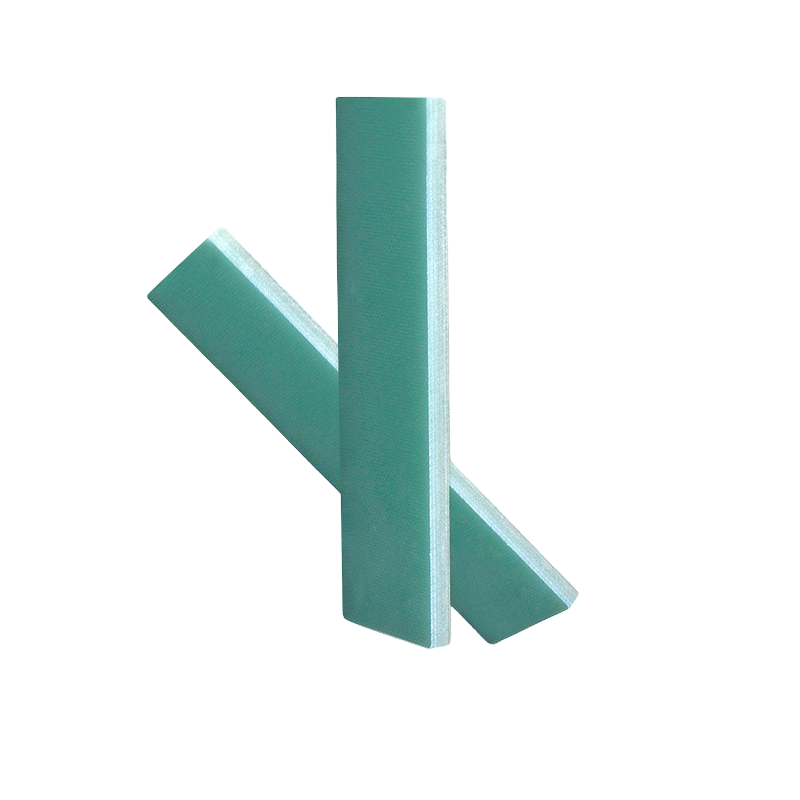
Green Fiberglass Board Factory: The Panel Flatness Decides the Fit
A green fiberglass board factory produces rigid fiberglass-reinforced laminate sheets, the green panels used as circuit-board substrates, insulating backings, structural plates, and protective panels in electrical and mechanical assemblies. Buyers usually compare panel thickness, sheet size, green shade, and advertised grade. The property that decides whether the board lays flat, cuts to size, and fits its position downstream is the flatness and dimensional squareness of the finished panel, and it is the part most buyers overlook.
Flatness is what the panel shows when it lies on a surface. A well-made laminate should rest evenly across its face, with no bow along the length, no cup across the width, and no twist that lifts one corner off the table. A warped panel does not sit against its mating part; it rocks or leaves a gap along one edge, and fastened parts tilt out of line. Controlling press pressure and cooling evenly across the sheet produces panels that stay planar instead of setting into a curve.
Warp and bow develop unevenly if the laminate cools or cures one-sidedly. Areas pressed or heated differently shrink at different rates, pulling the panel out of plane as it settles. A panel slightly warped off the line looks acceptable stacked in a bundle, but shows its curve once cut into a smaller part. Balancing pressure, temperature, and dwell across the full sheet keeps both faces and edges settling together, so the panel stays flat rather than bending after release.
Cut squareness decides how the sized part matches its opening. Panels should be cut to a straight edge and true right angle, with sides parallel and dimensions matching the stated size within tolerance. A panel cut off-square leaves one end narrower or one edge angled, and the finished part will not fit its frame or slot. Trimming panels to matched dimensions, and checking edge straightness and corner angle, keeps cut blanks usable in the intended position rather than requiring rework.
Dimensional accuracy prevents fit problems after machining. Once sawn or routed, the board should hold its width, length, and thickness as cut, without shrinking or swelling later. A sheet that shifts dimensionally after cutting leaves parts that do not line up with neighboring holes or mounts. Stable lamination and settled material keep the panel true to size, so a part cut to specification still matches its assembly position.
Surface planarity supports downstream processing. A flat even face sits flat against drilling jigs, laminating surfaces, and mating components; raised patches or uneven weave imprint catch on tools and do not seat squarely. Even pressing and a uniform cured surface keep the face planar rather than marked by local high or low spots. Flatness also holds through batch variation: panels from different runs should sit at the same plane, so one part does not sit proud of its neighbors in a layered assembly.
Lay a straightedge across the panel both ways and set a square to its corner: the test reads whether the face sits flat, whether edges run straight, and whether the angles are true. Those geometric qualities, more than the green color or listed thickness, decide whether the board becomes a part that fits cleanly downstream. A factory that keeps pressure, cooling, and cutting even across the sheet sends out planar, square panels that fit their positions; one that treats flatness as a side effect of pressing delivers boards that warp, cup, or cut off-square once taken out of the bundle.